

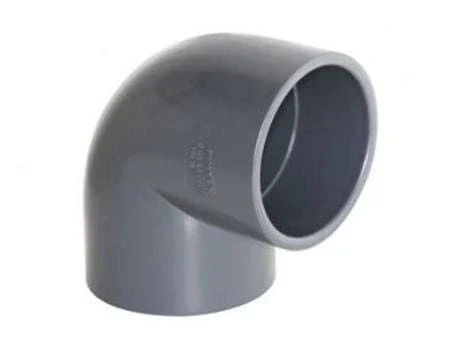
Description
A gentle bend for a pipe that should not turn at a right angle
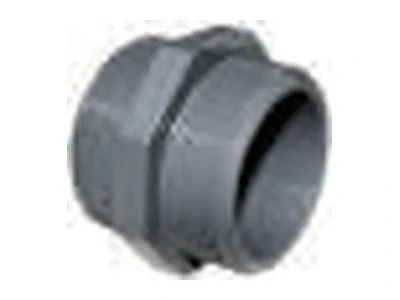
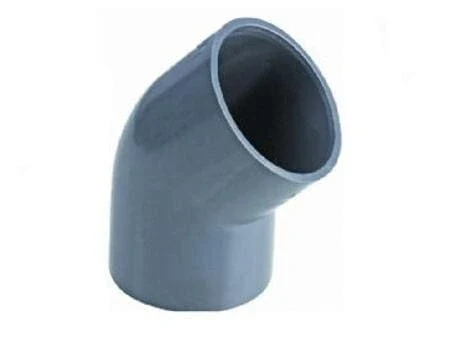
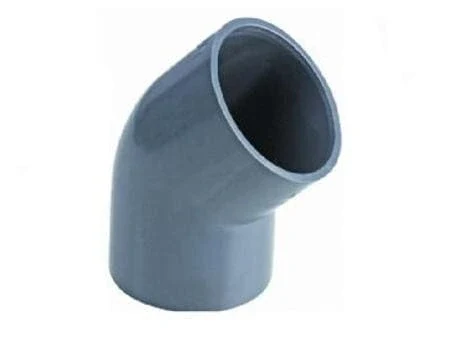
A 45° elbow is fitted wherever the line has to go around an obstacle or change direction gradually. The Atlas Pool model is made of thick-walled UH-PVC and is joined to the pipes with solvent cement – no thread and no sealant are needed. It works equally well in a pool plant room and in an ordinary water supply network.
What you get
- Type: 45° elbow, grey, solvent-weld socket connection.
- Material: thick-walled UH-PVC.
- Pressure: PN16, and PN10 for diameters 250–400 mm.
- Diameters: Ø20, Ø25, Ø32, Ø40, Ø50, Ø63, Ø75, Ø90, Ø110, Ø125, Ø140, Ø160, Ø200, Ø225, Ø250, Ø280, Ø315, Ø355 and Ø400.
- Application: pool filtration lines and water mains.
Why 45° instead of 90°
With a sharper bend the water hits the wall of the fitting and loses pressure. A 45° elbow is gentler on the flow. If you combine two of them, you get a total turn of 90°, and with a single elbow you can offset the line sideways without changing its direction completely. The smaller angle also helps when the pipe runs close to a wall, a flange or another pipe.
Dimensions and weight by diameter
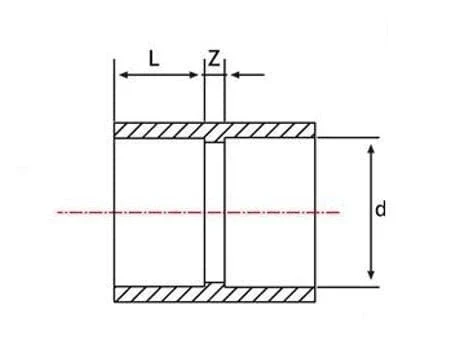
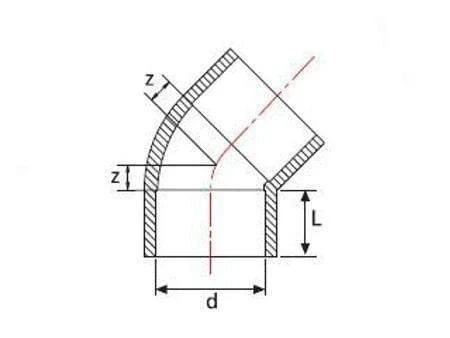
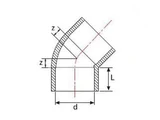
The designations DN, L and Z match those on the drawing supplied with the product. They let you calculate in advance how much pipe to cut between two fittings.
| Catalogue no. | Pipe Ø, mm | PN class | DN | Length L, mm | Offset Z, mm | Weight, kg |
|---|---|---|---|---|---|---|
| 502 00 020 2 | 20 | 16 | 15 | 16 | 5 | 0.016 |
| 502 00 025 2 | 25 | 16 | 20 | 19 | 6 | 0.026 |
| 502 00 032 2 | 32 | 16 | 25 | 22 | 8 | 0.046 |
| 502 00 040 2 | 40 | 16 | 32 | 26 | 10 | 0.068 |
| 502 00 050 2 | 50 | 16 | 40 | 31 | 12 | 0.114 |
| 502 00 063 2 | 63 | 16 | 50 | 38 | 14 | 0.218 |
| 502 00 075 2 | 75 | 16 | 65 | 44 | 17 | 0.344 |
| 502 00 090 2 | 90 | 16 | 80 | 51 | 20 | 0.530 |
| 502 00 110 2 | 110 | 16 | 100 | 61 | 25 | 0.872 |
| 502 00 125 2 | 125 | 16 | 110 | 69 | 28 | 1.324 |
| 502 00 140 2 | 140 | 16 | 125 | 76 | 32 | 1.266 |
| 502 00 160 2 | 160 | 16 | 150 | 86 | 36 | 1.924 |
| 502 00 200 2 | 200 | 16 | 175 | 106 | 43 | 3.584 |
| 502 00 225 2 | 225 | 16 | 200 | 119 | 49 | 3.890 |
| 502 00 250 4 | 250 | 10 | 250 | 132 | 60 | 5.474 |
| 502 00 280 5 | 280 | 10 | 250 | 147 | 66 | 7.510 |
| 502 00 315 4 | 315 | 10 | 300 | 165 | 74 | 9.960 |
| 502 00 355 5 | 355 | 10 | 350 | 193 | 84 | 9.650 |
| 502 00 400 4 | 400 | 10 | 400 | 208 | 94 | 17.850 |
How to glue it
- Dry-fit first. Position the elbow and the pipes and check which way the bend will point.
- Prepare the ends. Cut the pipe square, remove the burrs and degrease both surfaces.
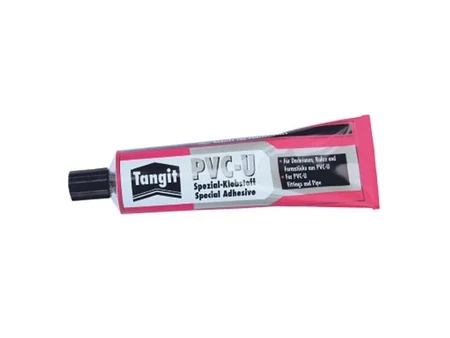
- Apply the cement and join. Use a cement for rigid PVC (for example Tangit PVC-U) and push in as far as it will go.
- Let it cure. Run water only after the time specified by the cement manufacturer.
Availability
Diameters 50 and 63 mm are usually kept in stock; the other sizes take longer to deliver.
Frequently asked questions
Does it have a thread?
No. The fitting is a solvent-weld socket and is connected by gluing only.
Can it be used in a pool?
Yes, it is designed for pool filtration lines and for water mains.
Where are the L and Z values?
In the table above. For example, for a 63 mm diameter, L is 38 mm and Z is 14 mm.
What should I do for a right angle?
Take a 90° elbow from the same series or glue two 45° elbows together.
See also: Wellness, Pools and Equipment, Plumbing Materials, Pools, Pool Chemicals, Pool Accessories.