


Description
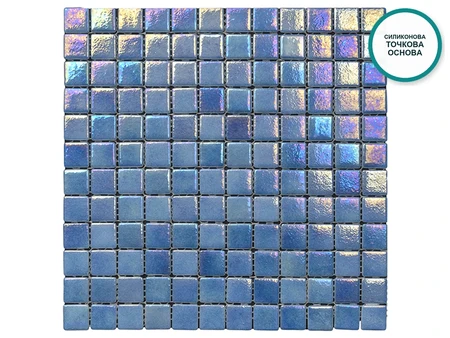
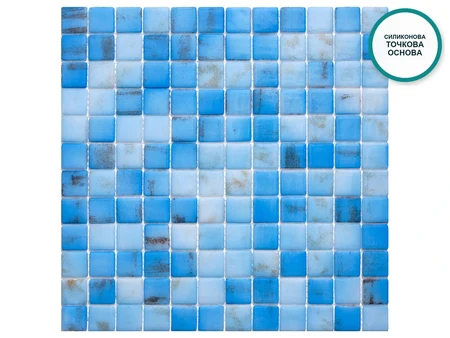
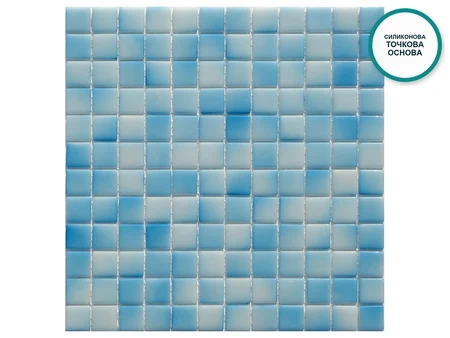
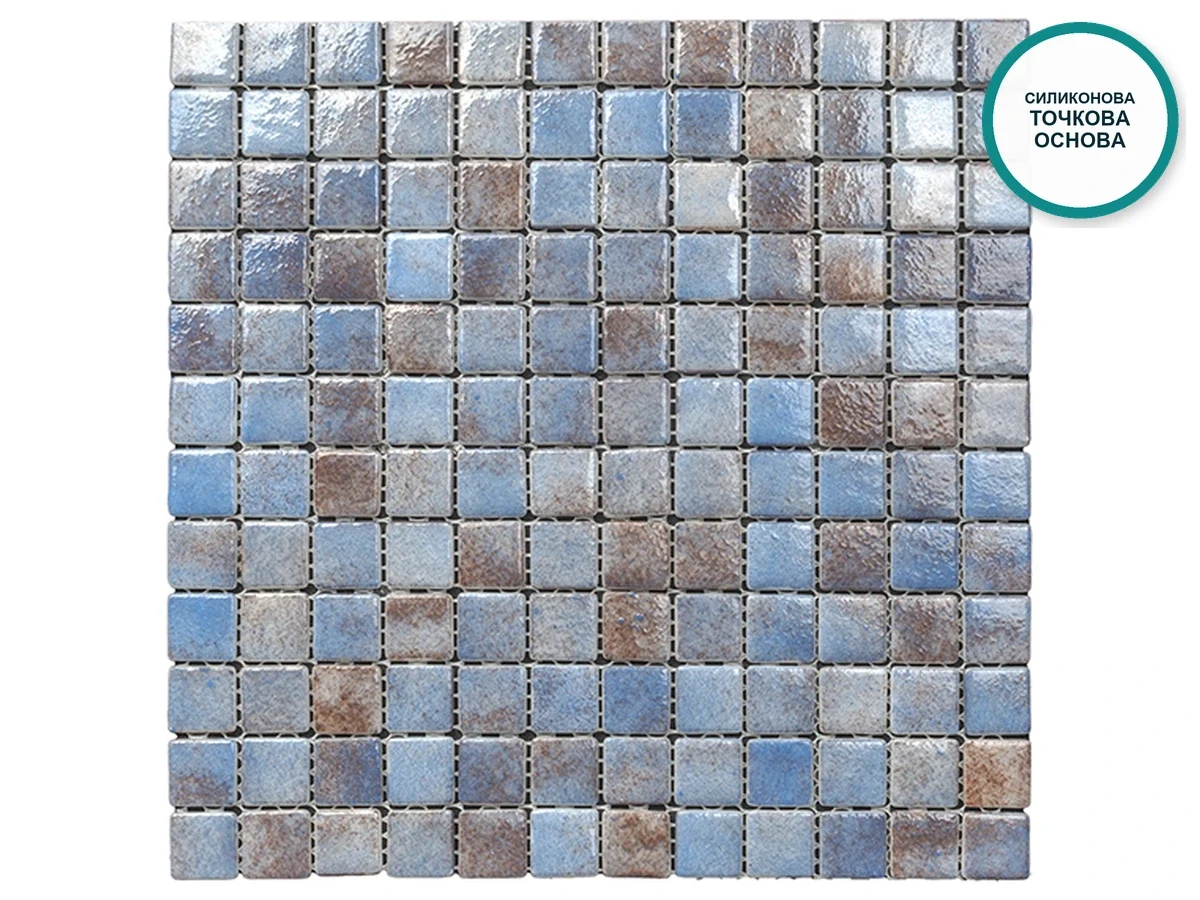
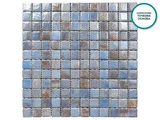
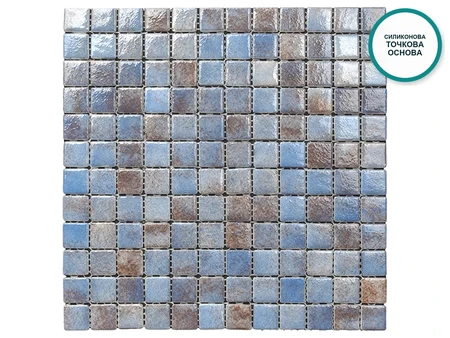
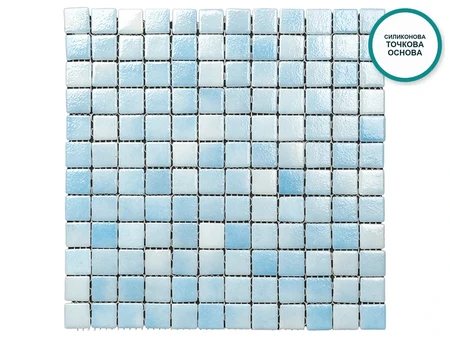
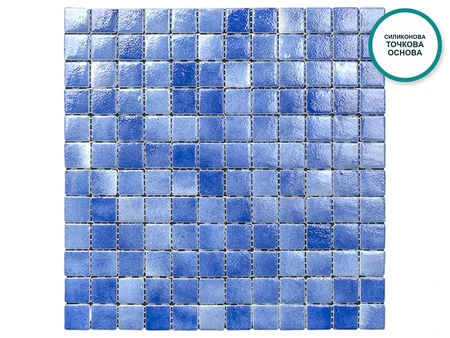
Glass-ceramic mix Spinalonga – grey-blue with brown shades
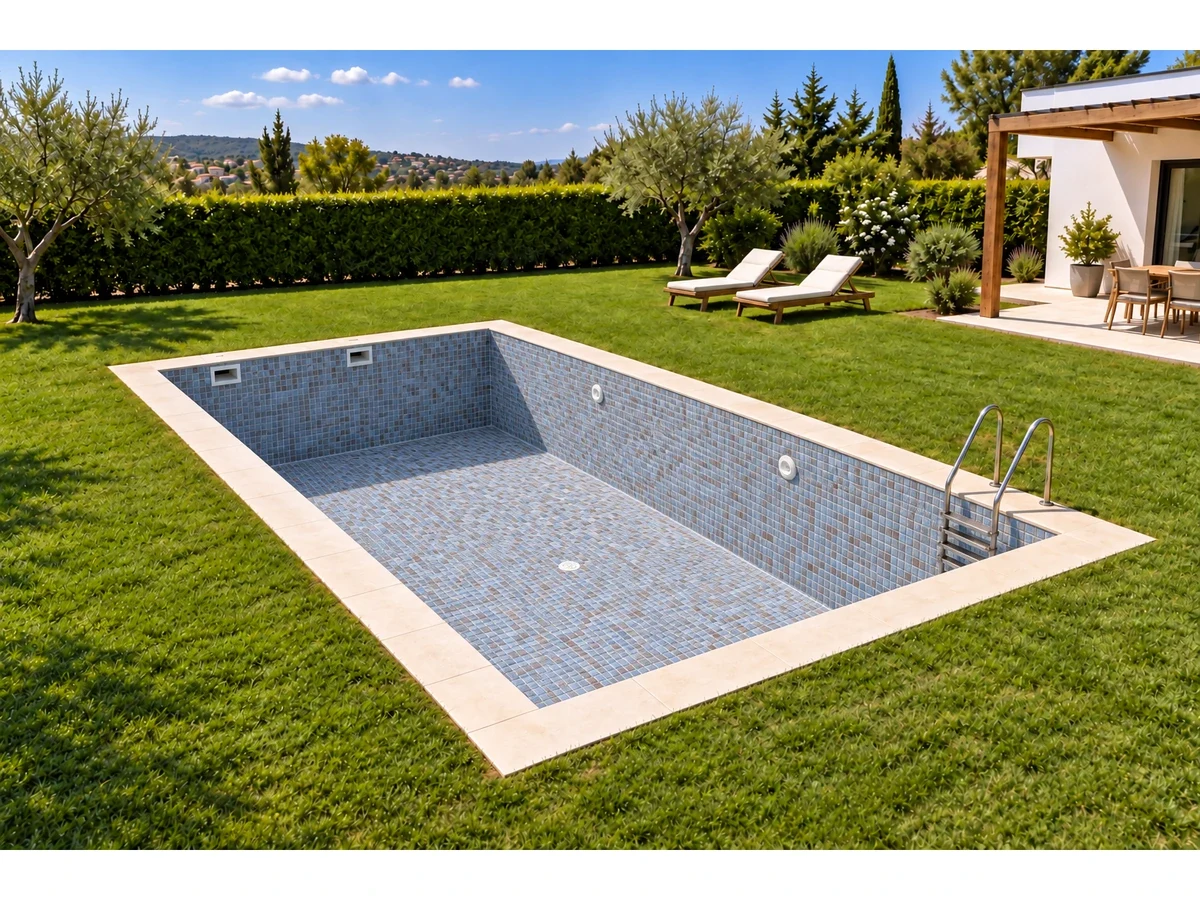
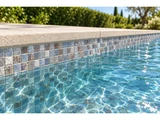
The grey-blue background is broken up with brown pieces – this is how water looks above wet rocks. The mosaic is rich in shades and stays vivid for years.
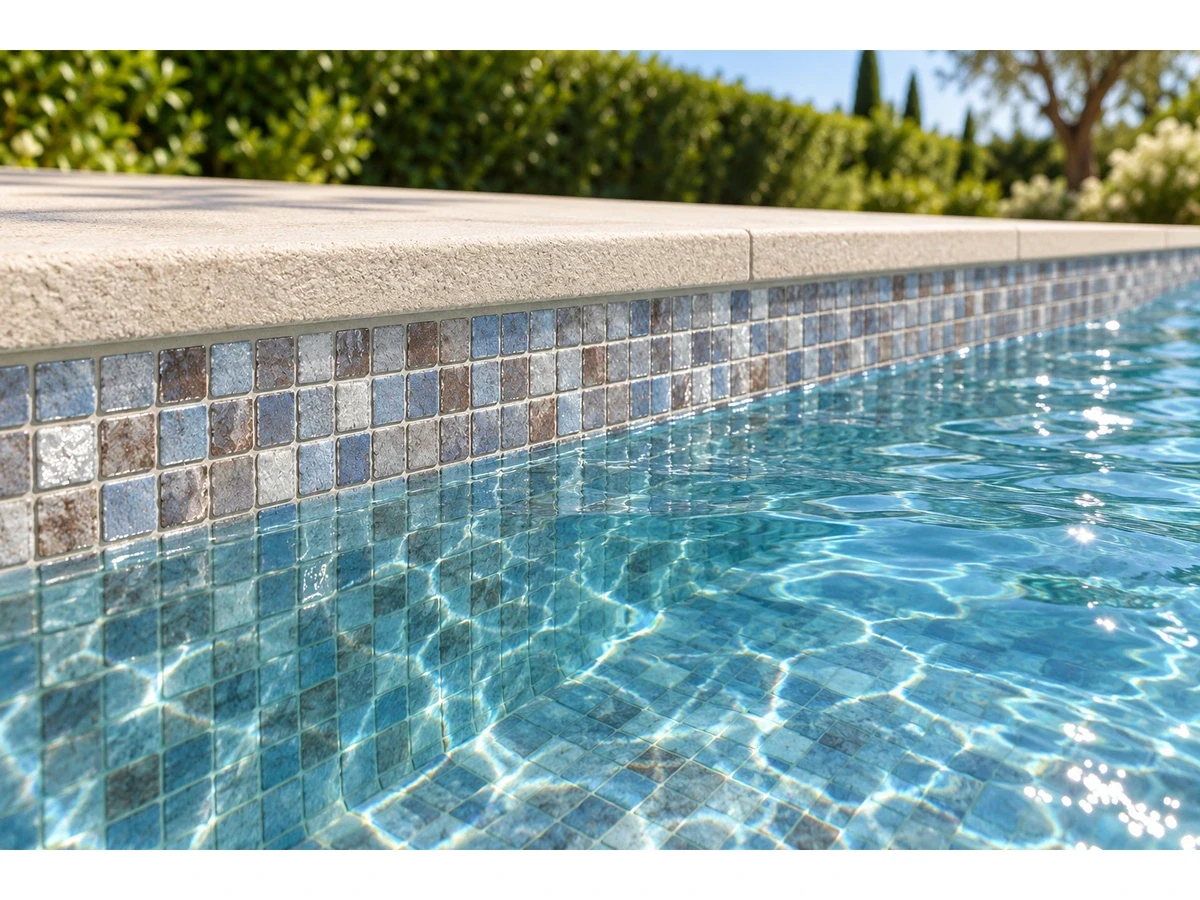
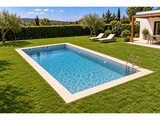
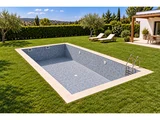
The surface is silky. Under water in the sun the blue plays, and the brown chips give it depth. Suitable for pools set in nature – with stone and wood.
What you get
- Square chips 25 × 25 mm, 4 mm thick
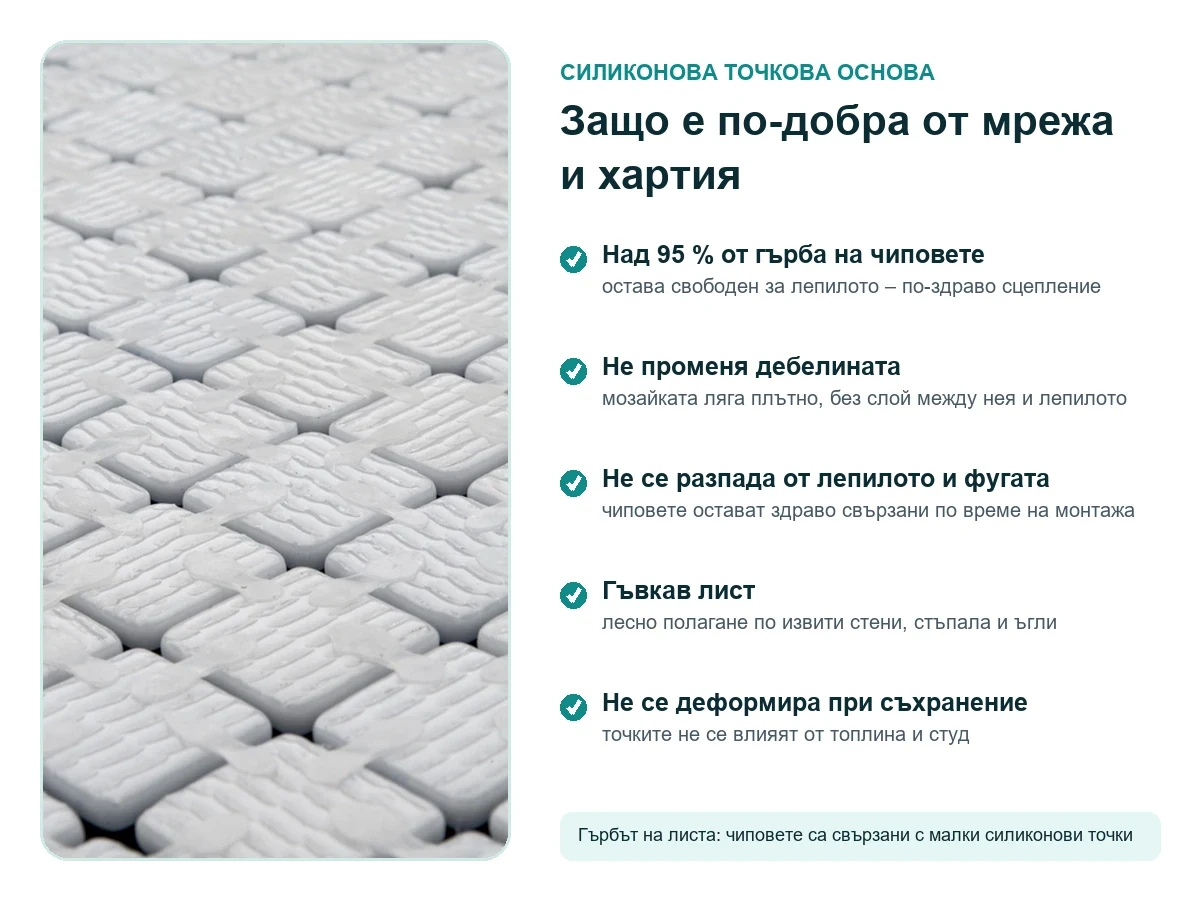
- Silicone dot backing that leaves the back of the chips uncovered
- Product code: MOSFBZM102
- Sold in cartons of 1 m²
Technical specifications
| Code | MOSFBZM102 |
|---|---|
| Material | glass ceramic, made entirely from recycled glass |
| Colour | grey-blue with brown shades |
| Chip shape | square |
| Chip | 25 × 25 mm |
| Thickness | 4 mm |
| Sheet | 317 × 317 mm |
| Sheets per 1 m² | 10 |
| Recommended grout joint | 2 mm |
| Backing | silicone (polyurethane) dots |
| Water absorption | no more than 0.04 % (tested to EN ISO 10545-3) |
| Flexural strength | 55 N/mm² |
| Freeze-thaw | resistant (ASTM C1026) |
| Chemical resistance | class A per ASTM C650 |
| Permanently in water | yes |
| Application | pools, hot tubs, spa areas, bathrooms and shower cubicles |
| Packaging | carton of 1 m² |
Advantages of the material
- Non-porous structure – water absorption up to 0.04 %, so no mould, stains or odours form.
- Designed for permanent immersion – in pools, hot tubs, fountains and overflow channels.
- The colour does not fade in the sun (ISO 4892) or from water treatment chemicals (class A, ASTM C650).
- Withstands freezing and thawing, so it has nothing to fear from an outdoor winter.
- Flexural strength 55 N/mm², smooth face without defects.
- Made from fully remelted glass, without lead, cadmium or other heavy-metal pigments.
The silicone dot backing
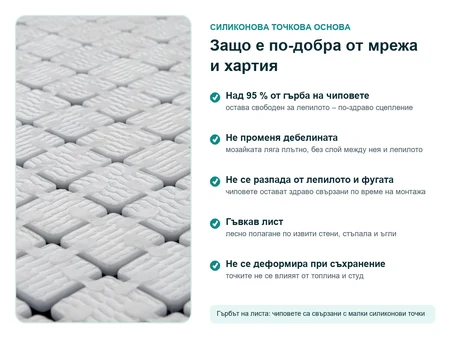
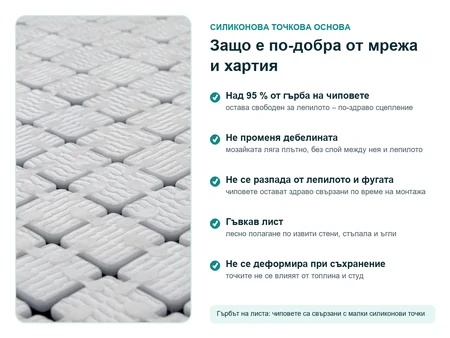
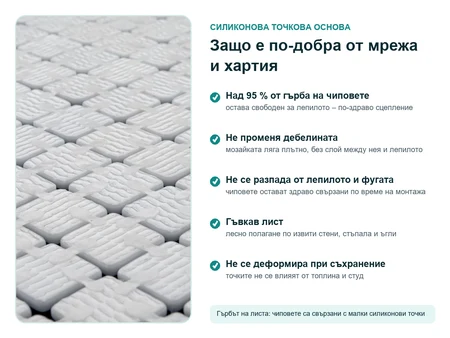
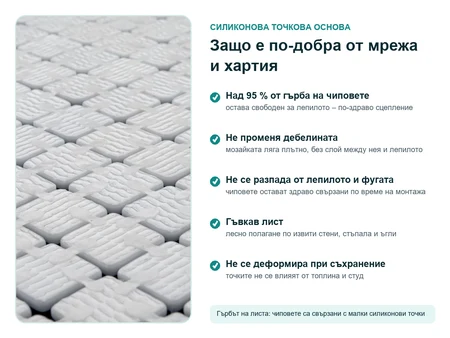
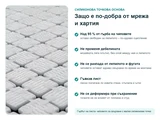
On the back, each sheet carries small silicone (polyurethane) dots that join the chips together and leave the back almost free. This way the adhesive reaches over 95 % of the surface of each chip and the bond is strong. The dots do not add thickness, are not affected by the adhesive and the grout, and the sheet does not warp in storage. It is flexible and therefore follows curved walls, steps and corners.
| Backing | Back free for adhesive | Laying on curves | After laying |
|---|---|---|---|
| Silicone dots | over 95 % | very easy, the sheet is flexible | nothing to remove; chips and joints are visible |
| Mesh | less, the mesh covers part of the back | easy | nothing to remove; chips are visible |
| Paper | the whole back, but the paper is on the front | difficult, the paper tears | the paper is soaked and peeled off; the chips are hidden under it |
How it looks in water
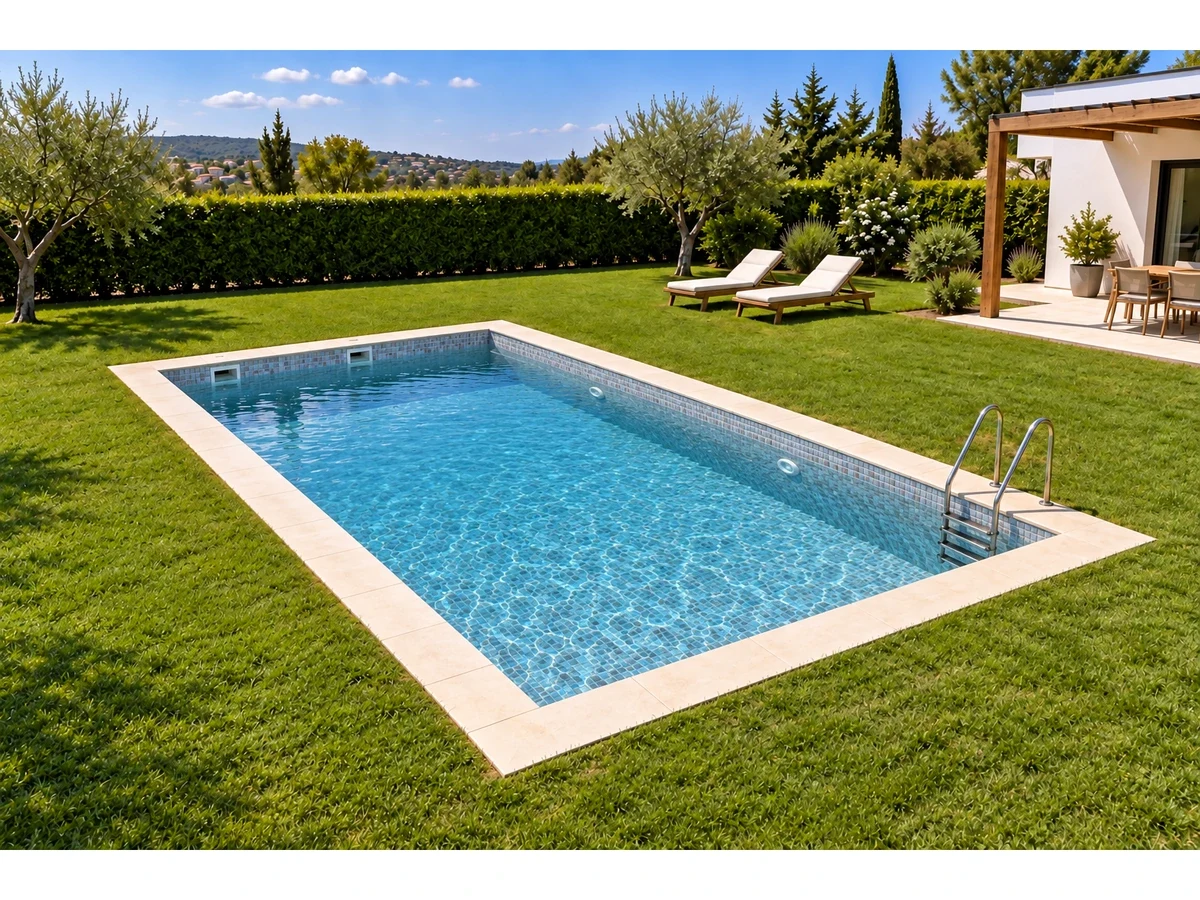
When wet, the colours become denser. Above the water you see the true tone of the sheet, while towards the bottom it deepens and sparkles in sunlight.
Where to use it
The sheets are used wherever there is water or moisture: for lining an entire pool, from the walls to the floor, for steps, seats and shallow relaxation areas, for hot tubs, steam saunas and spa corners, as well as for bathrooms at home, showers and walls you want to highlight.
Choosing the grout
Brown grout emphasises the earthy tones, while light grey freshens the blue. In a pool use epoxy grout: it is watertight, unaffected by chlorine and keeps its colour.
How to lay it
- Preparing the substrate: it must be dry, stable, free of dust and with unevenness under 2 mm over 2 m. For a pool, first of all, waterproof it with an elastic cement-based waterproofing membrane.
- Choosing the adhesive: an elastic cement-based white adhesive C2TE S1 is recommended; the glass is slightly translucent and a darker adhesive would reduce the brightness of the colour.
- Spreading: the adhesive is spread with a 3–4 mm notched trowel over an area large enough for two or three sheets.
- Placing: the sheets are pressed in with a rubber float, keeping a 2 mm gap between them, the same as the joint inside the sheet.
- Cutting: at corners and around jets, the dots that join the chips are cut through with a utility knife; individual chips are shaped with glass mosaic nippers.
- Grouting: starts the next day, 24 hours later.
- Washing off the excess: the grout is wiped with a damp sponge while it is still soft; epoxy grout is removed immediately with a special cleaner.
- Filling: water is let in after the grout has fully cured – about a week.
For installation you will also need: a waterproofing layer, light-coloured adhesive of class C2TE S1, grouting compound (epoxy or moisture-resistant), a notched trowel with 3–4 mm teeth, a rubber grout float, a utility knife, glass mosaic nippers, a sponge, a bucket of clean water.
Calculating quantities
First calculate the area of the floor and all the walls, then increase it a little for cutting waste. Example: a pool 8 × 4 m, 1.5 m deep. The adhesive is applied at an average of 2 kg per m² for chips up to 25 mm, 2.5 kg for 40 mm and 3 kg for larger formats. The grout for this product (chip 25 × 25 mm, 4 mm thick, 2 mm joint) is calculated as (A + B) / (A × B) × C × D × 1.6 kg/m². These are guidelines – the actual consumption varies with the smoothness and absorbency of the substrate, the chosen adhesive and grout, the teeth of the trowel, the depth of the joint, the geometry of the site and the skill of the installer. Therefore check the figures in the technical data sheets and consult your contractor.
Laboratory test results
- Water absorption – up to 0.04 % (standard EN ISO 10545-3).
- Flexural strength – 55 N/mm² (EN ISO 10545-4).
- Surface defects – none, 100 % of the chips are flawless (EN ISO 10545-2).
- Contact with chemicals – class A, colour and surface remain unchanged (ASTM C650).
- Freeze cycles – withstands them (ASTM C1026).
- Ultraviolet exposure – no visible change (ISO 4892).
- Thermal expansion – withstands it (EN ISO 10545).
Maintenance
For everyday cleaning a soft sponge or cloth and a mild cleaning agent are enough. Abrasive powders, wire brushes and acidic solutions damage the grout and should be avoided. The pool water should have a pH of 7.0 to 7.4 and normal hardness, otherwise limescale builds up on the joints. Go over the area around the waterline regularly with a special cleaner.
Practical tips
- Sold only in whole cartons of 1 m².
- Take the whole quantity at once, with a 5–10 % reserve, so that it comes from one batch and has a uniform shade.
- Laying over old tiles is possible if they are sound, clean, degreased and primed; in a pool, new waterproofing is recommended.
- Glass does not react with chlorine and salt, so it is suitable for saltwater.
Colour on screen and in real life
Glass looks alive and its tone changes with circumstances, so photos and visualisations may differ from the real thing. This depends on the screen (brightness, type), on daylight or artificial light, on the viewing angle, on the water in the pool – its depth, clarity, chemical composition and the reflection of the sky – on the grout, the adhesive and the size of the tiled surface, on surrounding materials and plants, on the production batch and on the natural variation between chips in the mixes. Visualisations are for guidance only.
See also: Wellness, Pools and Equipment, Cladding and Paving, Pools, Pool Chemicals, Pool Accessories.