


Description
Faro: character and look
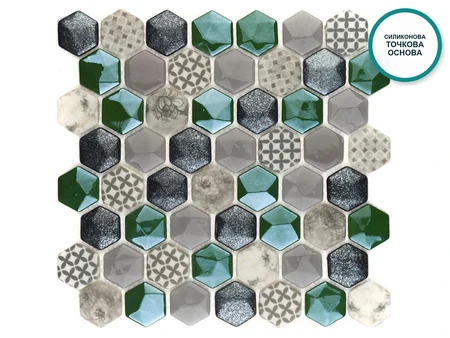
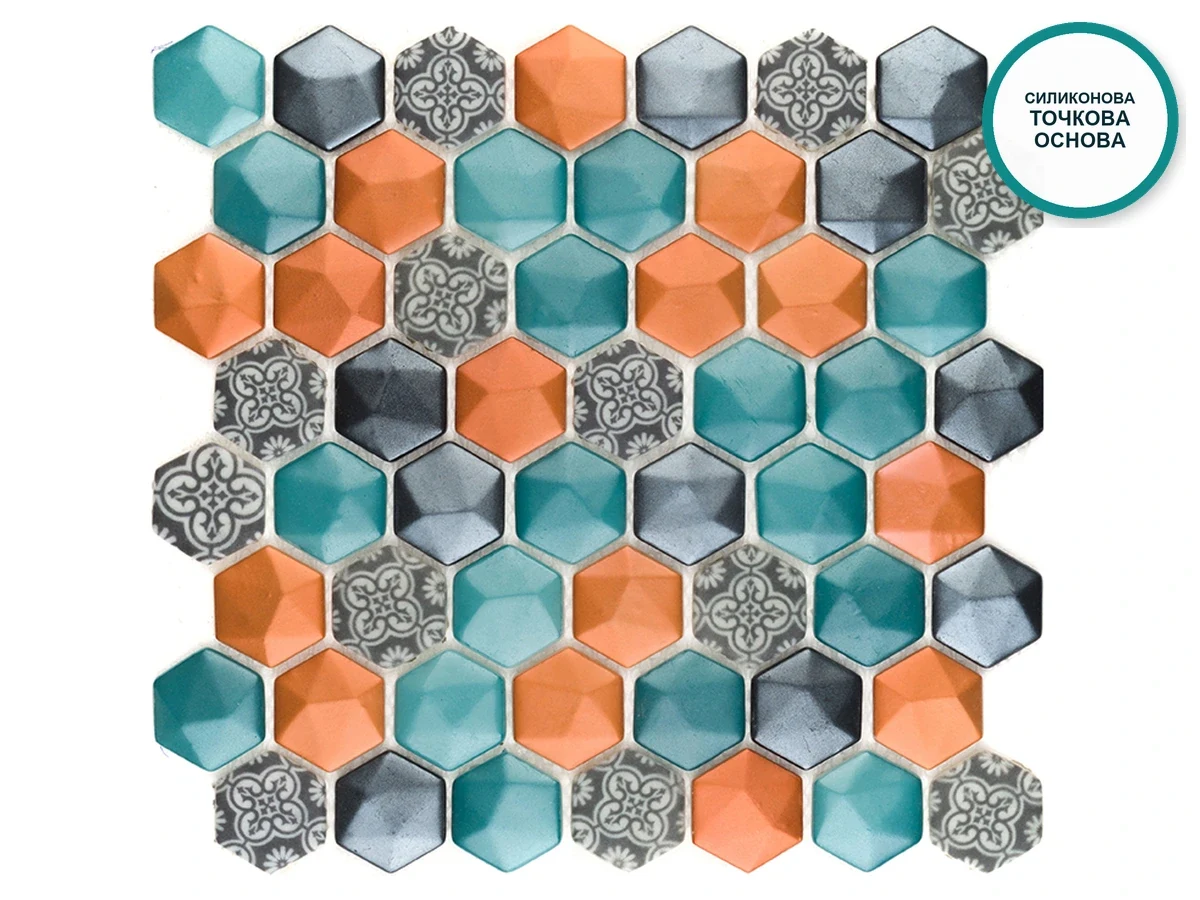
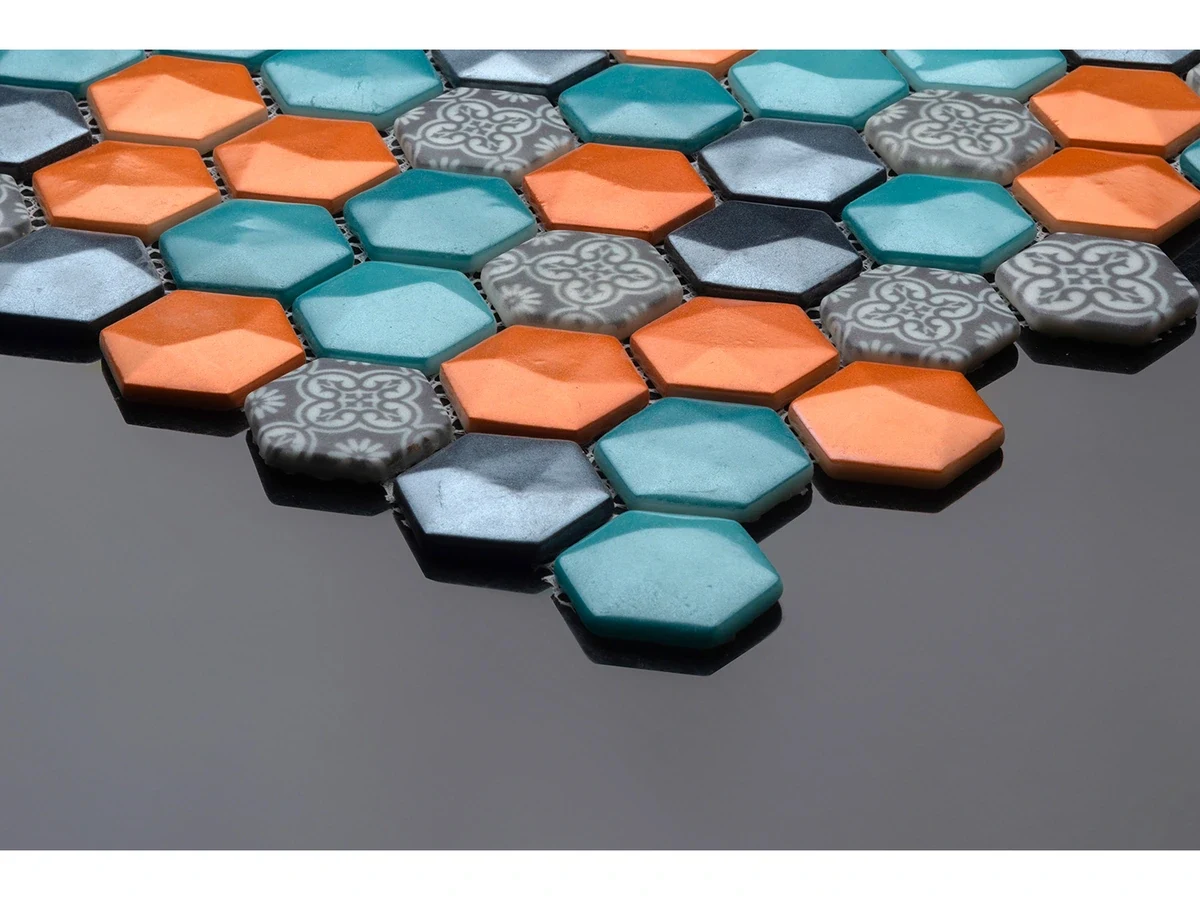
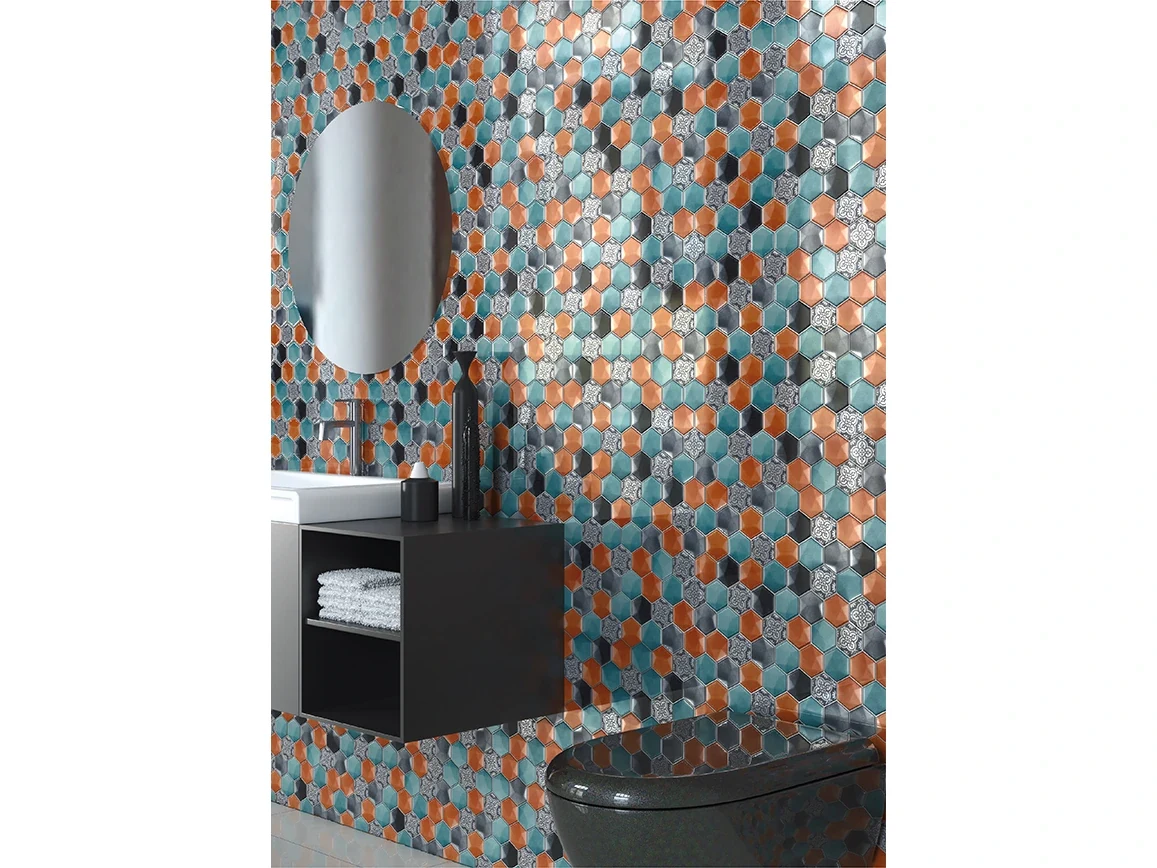
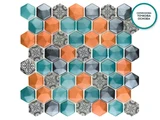
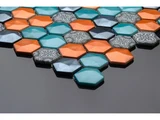
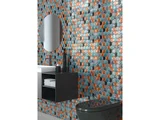
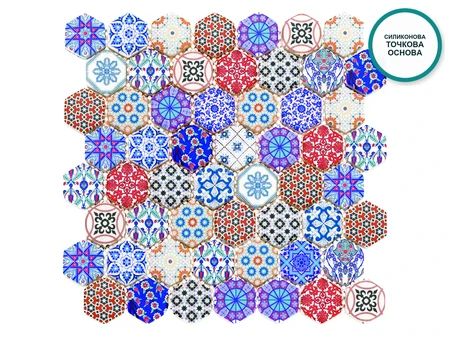
Faro is a cheerful Mediterranean mix: turquoise and orange hexagonal pieces alternate with tiles decorated with ornaments. The result is a lively, colourful surface for a feature wall in a bathroom or a spa area with an artistic spirit.
The cladding consists of a turquoise-orange mix of hexagons with a colourful pattern. Water and light bring it to life and give it depth.
What you get with Faro
- Pore-free surface – the glass absorbs at most 0.04 % water, so there is no mould, lasting stains or unpleasant odours on it.
- Colour that lasts – sunlight (ISO 4892) and cleaning chemicals (class A per ASTM C650) do not fade it.
- Frost resistance – many freeze-thaw cycles (ASTM C1026) do not harm it, so outdoor use is possible too.
- Stability – flexural strength of 55 N/mm² and a flawlessly smooth surface.
- Clean composition – the raw material is entirely recycled glass, and the pigments contain no lead, cadmium or other heavy metals.
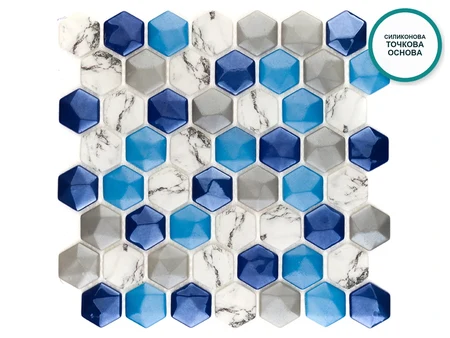
Silicone-dot backing
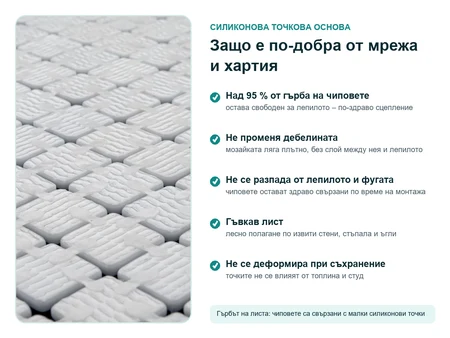
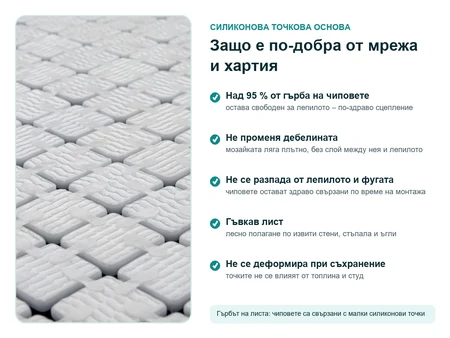
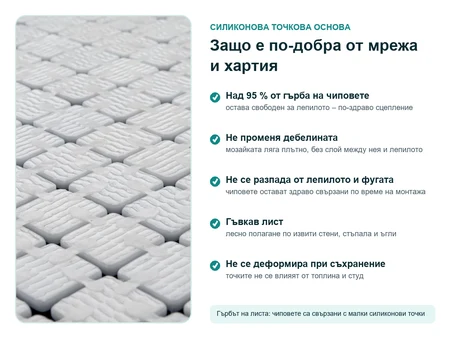
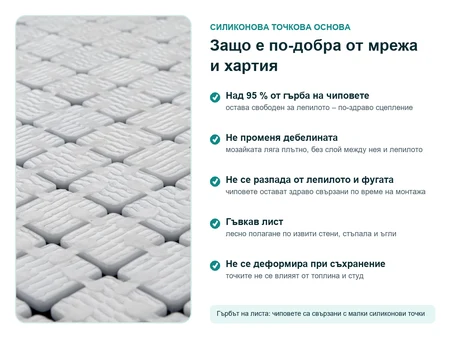
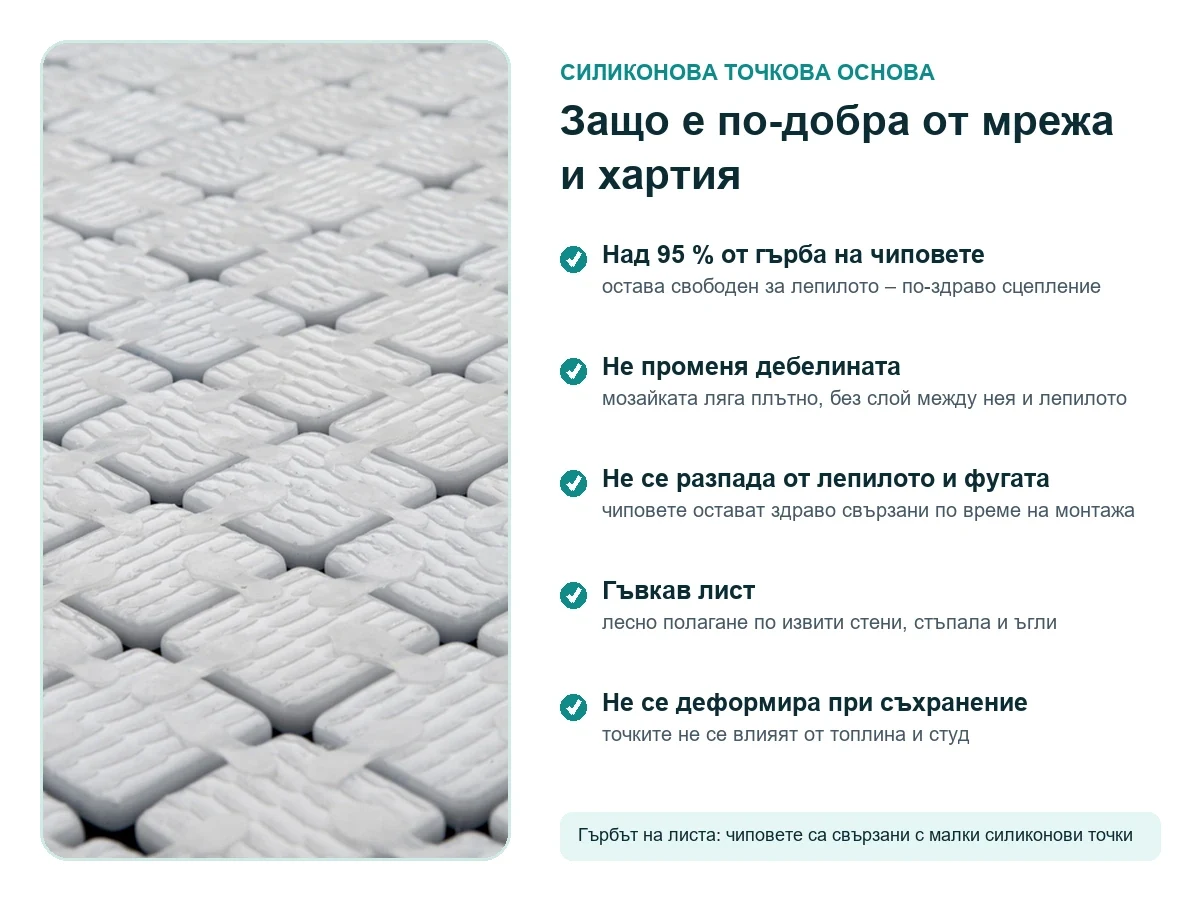
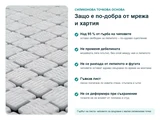
With Faro, the chips are held together by small dots of silicone (polyurethane) on the back. They do not block the back, so the adhesive reaches over 95 % of it and the bond is stable. The dots do not add to the thickness of the sheet, are not dissolved by the adhesive and grout, and do not allow deformation during storage. The sheet is flexible and follows curves, steps and corners.
| Criterion | Silicone dots | Mesh | Paper |
|---|---|---|---|
| Adhesive access to the back | over 95 % of the back | limited, the mesh covers part of it | full, but the paper is on the face side |
| What is visible during installation | chips and joints | chips | only the paper |
| Curved areas and corners | extremely easy, the sheet bends | easy | difficult, the paper tears |
| After installation | nothing to remove | nothing to remove | the paper is moistened and peeled off |
Product specifications
| Article code | MOSFBADJ002 |
|---|---|
| Model | Faro |
| Chip shape | hexagon with a printed pattern |
| Colour range | turquoise-orange with a colourful pattern |
| Material | glass-ceramic from 100 % recycled glass |
| Sheet backing | silicone (polyurethane) dots |
| Size of one sheet | 300 × 290 mm |
| Sheets per 1 m² | 13 |
| Recommended grout width | 2 mm |
| Surface defects | none – every chip is free of defects (test EN ISO 10545-2) |
| Water absorption | maximum 0.04 %, measured to EN ISO 10545-3 |
| Flexural strength | 55 N/mm², method EN ISO 10545-4 |
| Frost resistance | withstands freezing and thawing (ASTM C1026) |
| Chemical resistance | class A – no change (ASTM C650) |
| Lightfastness | no change under UV exposure (ISO 4892) |
| Thermal expansion | passes the test to EN ISO 10545 |
| Intended use | wall cladding in wet and dry rooms: bathroom, shower, kitchen, spa and hammam, as well as decorative surfaces |
| Packaging | one carton contains 1 m²; sold by whole cartons only |
Ideas for using Faro
- Cladding of a single feature wall in the bathroom
- Kitchen backsplash with a decorative pattern
- Decorative panels in hotels, restaurants and spa complexes
Which grout to choose
Grey grout pulls the colours together into one picture, while a dark one makes them more saturated. When the mosaic is in a shower or another permanently wet place, use an epoxy or waterproof C2 grout – it does not let moisture through and does not darken over time.
Installation steps
- Substrate. The wall should be dry, stable and dust-free, with a deviation of up to 2 mm per 2 m. In the shower, waterproofing comes first.
- Choosing the adhesive. Use a white flexible cement adhesive C2TE S1; glass lets a little light through, and a grey adhesive would make the colour duller.
- Spreading. A notched trowel with 3–4 mm teeth covers an area for 2–3 sheets.
- Pressing. The sheet is placed and pressed in with a rubber float. The spacing between neighbouring sheets is kept the same – 2 mm.
- Cutting. In corners and around outlets the silicone dots are cut through with a utility knife, and single chips are snapped off with glass mosaic nippers.
- Grouting. Start after 24 hours. In the shower area use an epoxy or waterproof C2 grout.
- Cleaning. A damp sponge removes the grout while it is still soft; epoxy requires immediate action with a special cleaning product.
- Putting into use. The wet room is used only once the grout has fully hardened.
You will need: white adhesive C2TE S1, epoxy or waterproof grout, a notched trowel with 3–4 mm teeth, a rubber float, a utility knife, glass mosaic nippers, a sponge, a bucket and clean water.
Planning the quantity
Multiply the height by the width of each wall and add 5–10 % extra for cutting. The item comes in cartons of 1 m² each, so buy everything at once – that way the sheets come from the same production run and show no difference in shade. For the adhesive, count roughly 2 kg per m² for chips up to 25 mm, 2.5 kg for 40 mm and 3 kg for larger ones. The figures are only a guide – the exact amount varies with the unevenness and absorbency of the wall, the brand of adhesive and grout, the size of the trowel teeth, the joint profile and the installer's skill. So check the consumption figures in the technical data sheets of the materials you choose.
Surface care
- A soft sponge or cloth with a neutral cleaning product is enough for daily cleaning.
- Do not use abrasive powders, wire brushes or acids on the grout.
- A rubber squeegee after showering leaves the smooth glass free of drops and stains.
Quick answers
What is Faro fixed with?
With a white flexible cement adhesive C2TE S1, which does not distort the colour of the glass.
Can it be installed over old tiles?
Yes – provided they are sound, clean, degreased and treated with a suitable primer.
Can I buy less than a carton?
No. The packaging is a carton of 1 m² and it is sold by whole cartons.
Is it suitable for a pool with salt water or chlorine?
It is intended for walls and wet areas; the glass does not react to cleaning products.
Why the shade in real life may differ
Glass is a material with a rich play of light, and its colour depends on the circumstances, so the real tone often differs from photos and computer images. The reasons are:
- a monitor, phone or tablet with different brightness and calibration;
- the light – sunny, cloudy or artificial, the colour of the bulbs, the time of day;
- the viewing angle, from which glass reflects differently;
- the water in the pool – depth, clarity, chemical composition and the reflection of the sky intensify the blue;
- the tone of the grout and adhesive and the size of the covered area;
- the surrounding colours – coping, paving, walls and vegetation;
- the production batch – the shade may deviate slightly between two batches;
- the natural difference between chips in mixes and in glass with effects.
The images shown are illustrative and give only a general impression. If the exact shade is decisive for your choice, ask us before you order.
See also: Wellness, Pools and Equipment, Cladding and Paving, Pools, Pool Chemicals, Pool Accessories.