

Description
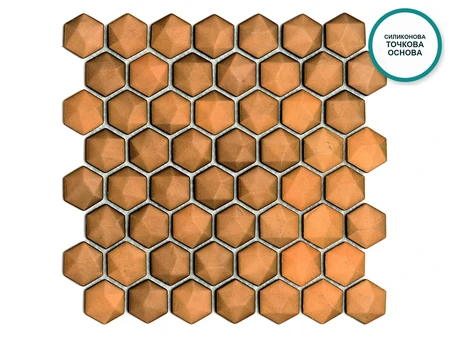
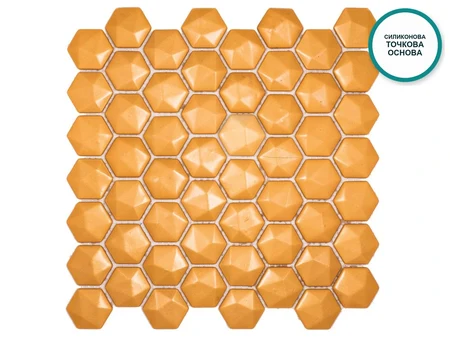
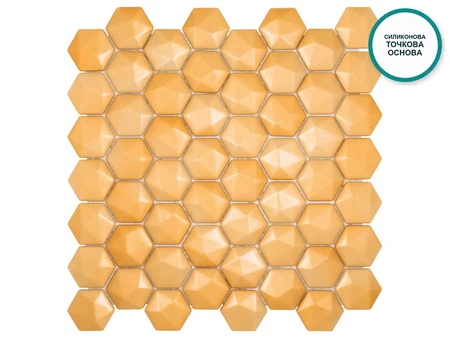
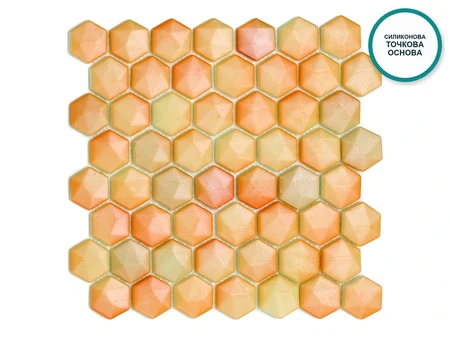
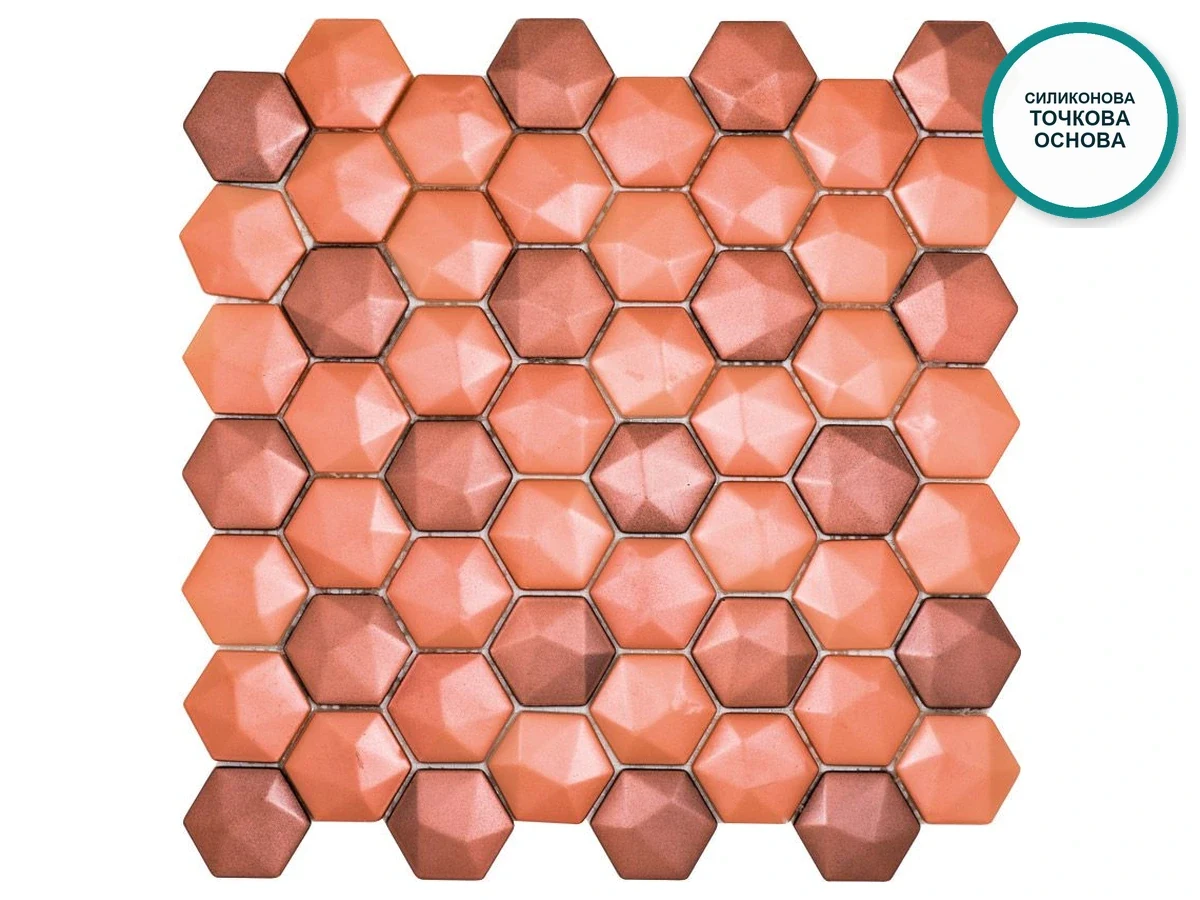
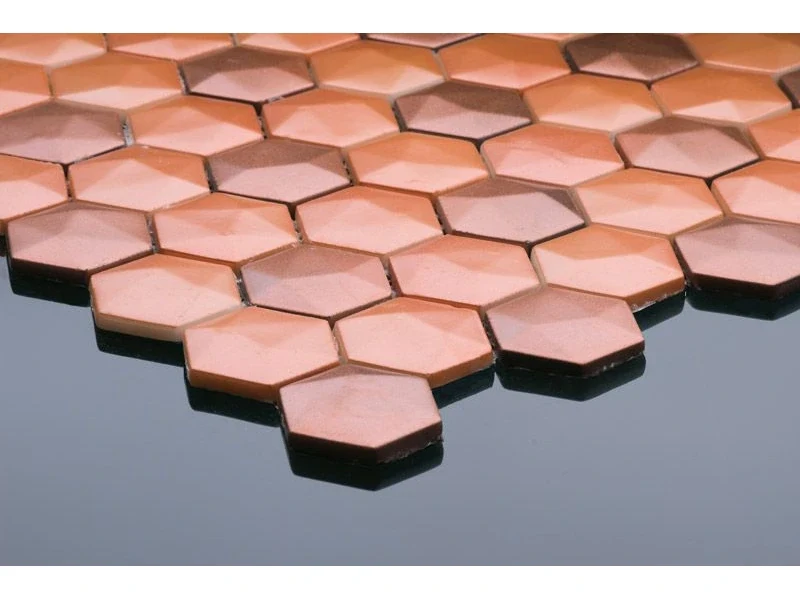
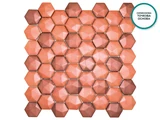
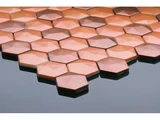
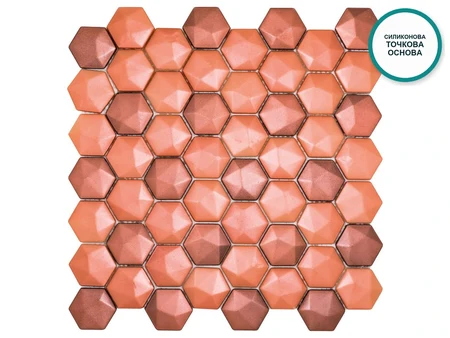
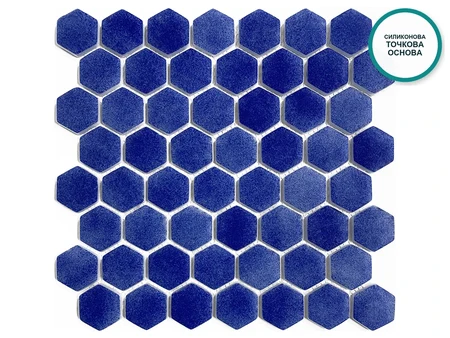
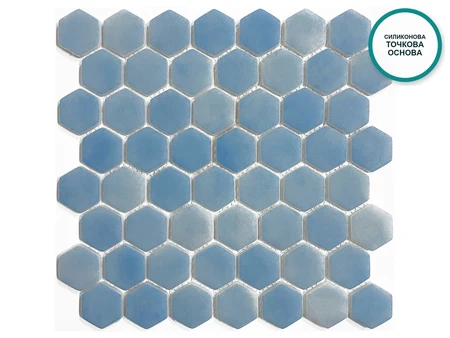
Coral hexagons in warm tones with faceted, slightly translucent faces that recall sea coral. It suits an accent wall in a bathroom or spa with a tropical spirit; the facets play with the light. The Curieuse mosaic (code MOSFBA104) is made of glass-ceramic hexagons and comes on ready-to-stick sheets.
What You Get
- Sheet size 300 × 290 mm; 13 sheets are needed for one square metre.
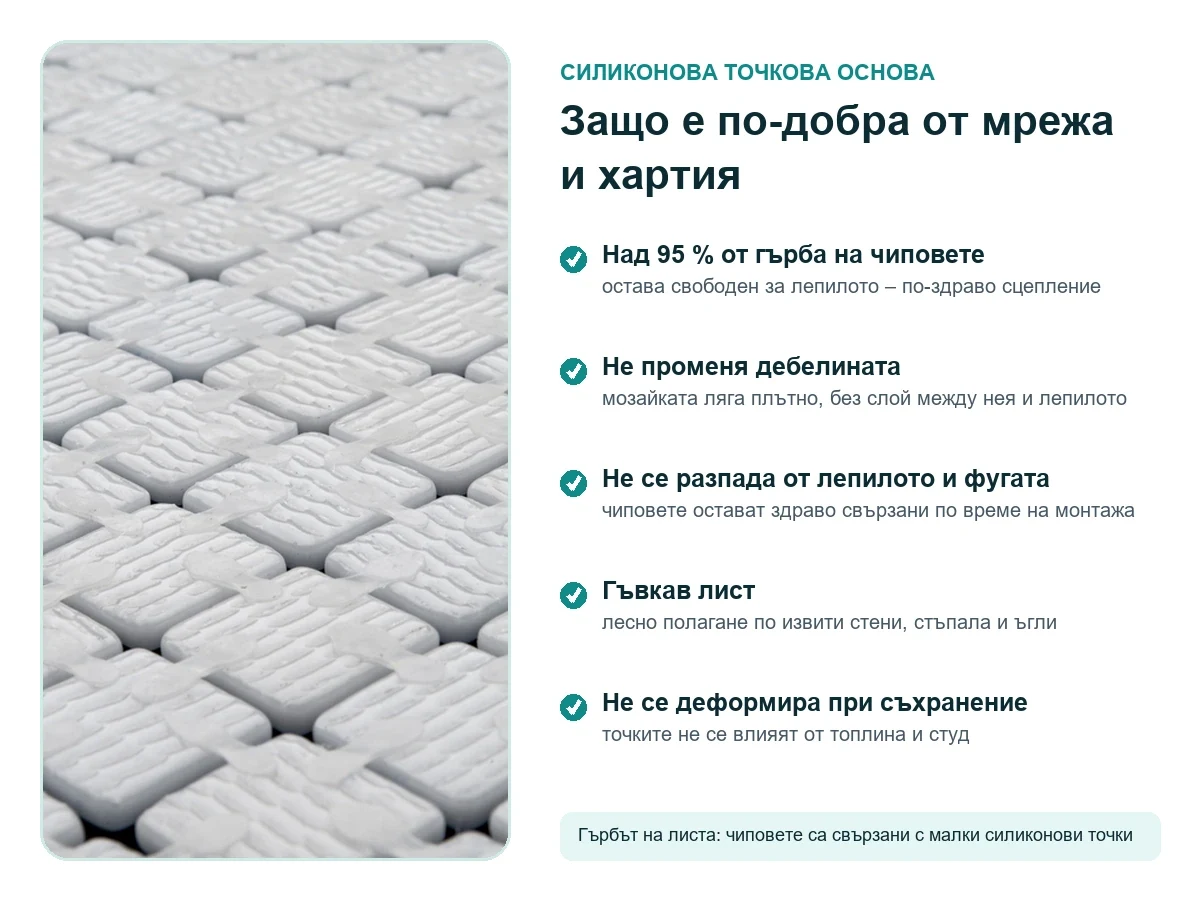
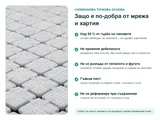
- Flexible silicone dot backing instead of mesh or paper.
- Made of 100% recycled glass, tile thickness 5.5 mm.
- Recommended grout joint between sheets: 2 mm.
Why Glass Ceramic Is a Great Choice
- Non-porous: water absorption is no more than 0.04%, so the surface does not grow mould and does not hold stains or odours.
- Colour-fast: UV ageing (ISO 4892) does not change it, and cleaning agents do not affect it (class A according to ASTM C650).
- Frost resistance: repeated freezing and thawing (ASTM C1026) does not harm it, so it is also suitable for outdoor areas.
- Strength: flexural strength of 55 N/mm² (EN ISO 10545-4), and the surface is smooth and free of defects.
- Eco-friendly: the raw material is recycled glass, and the colours contain no lead, cadmium or other heavy-metal pigments.
The Silicone Dot Backing
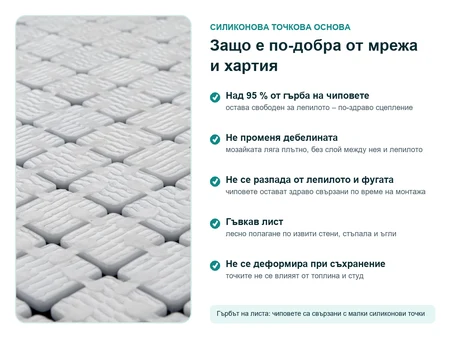
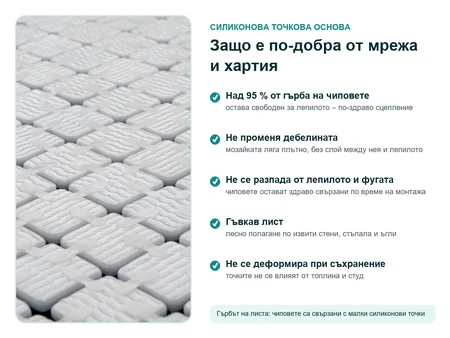
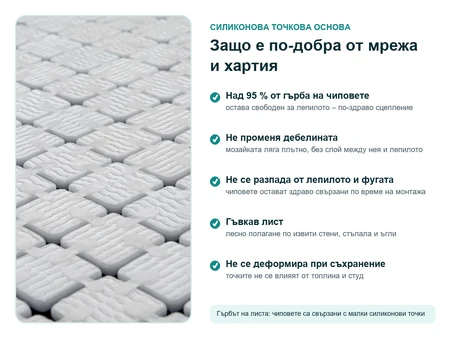
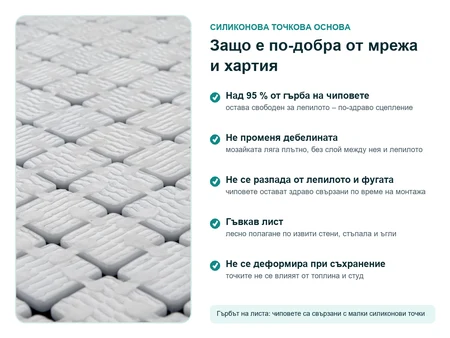
On the back, the tiles are joined by small polyurethane dots that leave the back almost completely exposed. As a result, the adhesive reaches over 95% of each tile, and the bond is more stable than with mesh. The dots add no thickness, are not affected by the adhesive or the grout, and the sheet does not warp in storage. Thanks to its flexibility, the tiling easily follows curved walls, steps and corners.
| Backing | Free area for the adhesive | Laying on curves | After installation |
|---|---|---|---|
| Silicone dots | over 95% of the back | very easy | nothing to remove |
| Mesh | smaller, because the mesh covers part of the back | easy | nothing to remove |
| Paper | the entire back | difficult, the paper tears | the paper is soaked and peeled off |
Technical Specifications
| Colour | coral-orange |
|---|---|
| Model / code | Curieuse / MOSFBA104 |
| Tile type | hexagon |
| Material | 100% recycled glass (glass ceramic) |
| Thickness | 5.5 mm |
| Size of one sheet | 300 × 290 mm |
| Sheets per square metre | 13 |
| Gap between sheets | 2 mm |
| Tile fixing | silicone (polyurethane) dots on the back |
| Water absorption | no more than 0.04% according to EN ISO 10545-3 |
| Flexural strength | 55 N/mm² according to EN ISO 10545-4 |
| Surface | 100% free of defects according to EN ISO 10545-2 |
| Freeze and thaw | resistant, tested according to ASTM C1026 |
| Chemicals | class A according to ASTM C650, no change |
| Light | UV ageing according to ISO 4892 – no change |
| Thermal expansion | resistant (EN ISO 10545) |
| Packaging | cartons of 1 m²; not split |
| Intended use | bathroom, shower, kitchen, spa, hammam, decorative walls |
Where to Use It
- accent walls in bathrooms and spa areas;
- pool and jacuzzi cladding;
- kitchen backsplash between the worktop and the cabinets;
- decorative niches and columns.
Choosing the Grout
A beige grout softens the colour, while a white one makes it brighter. When the mosaic is in a shower or another wet area, use an epoxy or moisture-resistant C2 grout – it does not absorb water and does not wear away over time.
Installation Steps
- Preparing the substrate: level (up to 2 mm over 2 m), dry, sound and dust-free. In the shower area, waterproofing is applied first.
- Adhesive: white flexible cement-based adhesive, class C2TE S1. The tiles are semi-translucent, and a grey adhesive would make the colour darker.
- Application: with a 3–4 mm notched trowel, cover an area for 2–3 sheets.
- Laying: press the sheet down with a rubber float and leave the same 2 mm between the sheets.
- Cutting: at corners and around fixtures, cut through the dots with a utility knife, and trim individual tiles with glass mosaic nippers.
- Grouting: wait a day. In the shower area, opt for an epoxy or moisture-resistant C2 grout.
- Wiping off: fresh grout is removed with a wet sponge, and epoxy grout immediately with a special cleaning agent.
- Putting into use: the shower water is turned on only once the grout has fully hardened.
Also get your tools ready: a notched trowel and a rubber float, a utility knife, special glass mosaic nippers, a sponge, a bucket of clean water, as well as the white adhesive and the suitable grout.
How Much Material to Calculate
Calculate the area of each wall (length times height) and add an allowance for cutting – 5–10%. For the adhesive, count on about 2 kg per square metre for tiles up to 25 mm in size; for 40 mm – 2.5 kg, and for even larger ones – 3 kg. In practice, quantities vary with the condition of the wall, the adhesive, the grout, the teeth of the trowel and the installer's technique, so check the figures in the technical data sheets of the materials you will use.
Caring for the Tiling
- Clean with a soft cloth or sponge and a neutral cleaning agent.
- Keep away from abrasive powders, wire brushes and acidic grout solutions.
- A rubber squeegee after showering protects against water stains.
Frequently Asked Questions
What adhesive is needed?
White flexible cement-based adhesive C2TE S1, because it preserves the true colour of the glass.
Can it be glued over old tiling?
Yes, provided the old tiles are sound, clean and degreased and have been primed with a suitable primer.
Is it suitable for chlorine and salt water?
It is intended for walls and wet areas, and the glass does not react with cleaning agents.
How much mosaic should I get?
It is sold in multiples of a 1 m² carton. Take the whole quantity at once so that it comes from a single production batch and has a uniform shade.
Colour in the Photo and in Real Life
Glass is a variable material, and its shade changes depending on the screen, the lighting (sun, overcast sky, lamps), the viewing angle, the water in the pool, the colour of the grout and the adhesive, the surrounding surfaces and the production batch. With mixes and effect types, there is also a natural difference between the individual tiles. The visualisations are illustrative and serve only as a guide.
See also: Wellness, Pools and Equipment, Cladding and Paving, Pools, Pool Chemicals, Pool Accessories.