
Description
Aosta mosaic – glass ceramic for wet and dry rooms
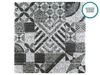
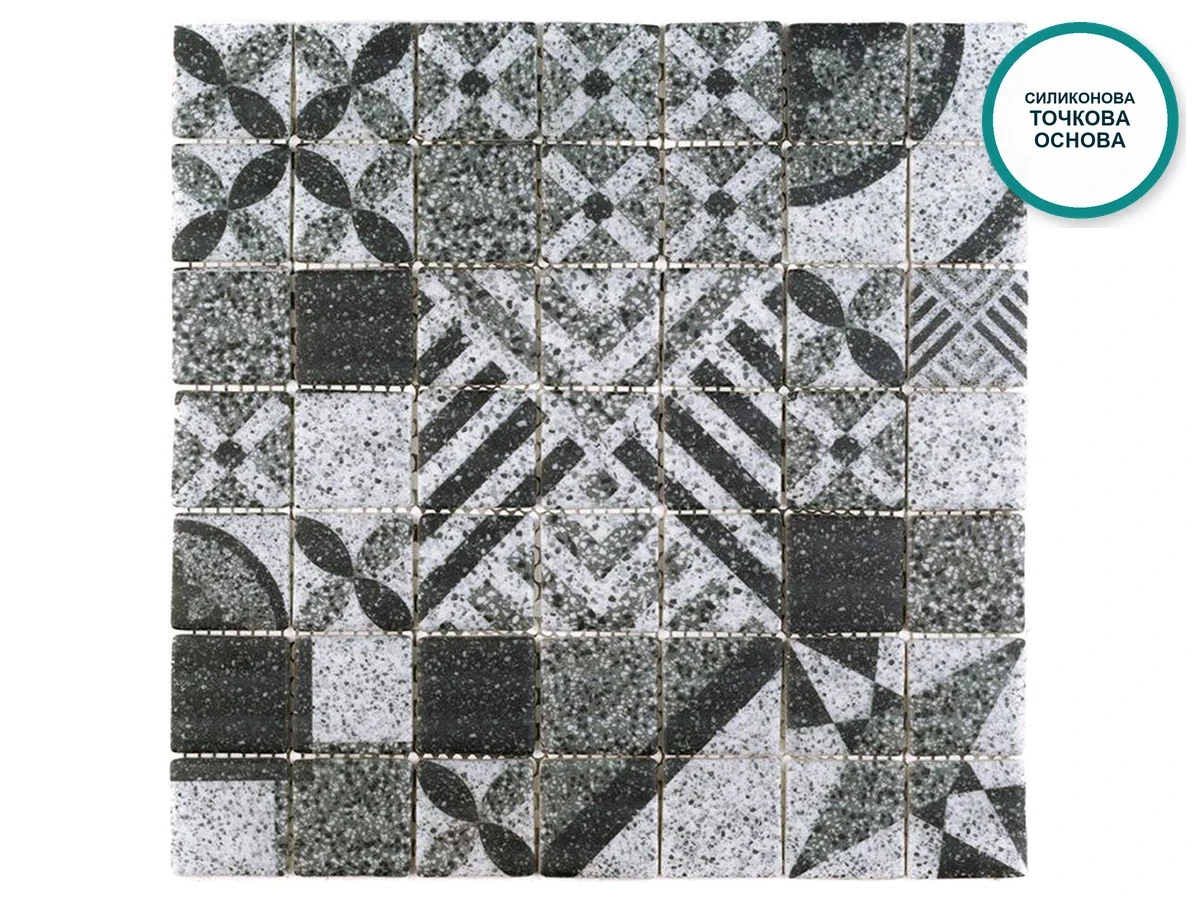
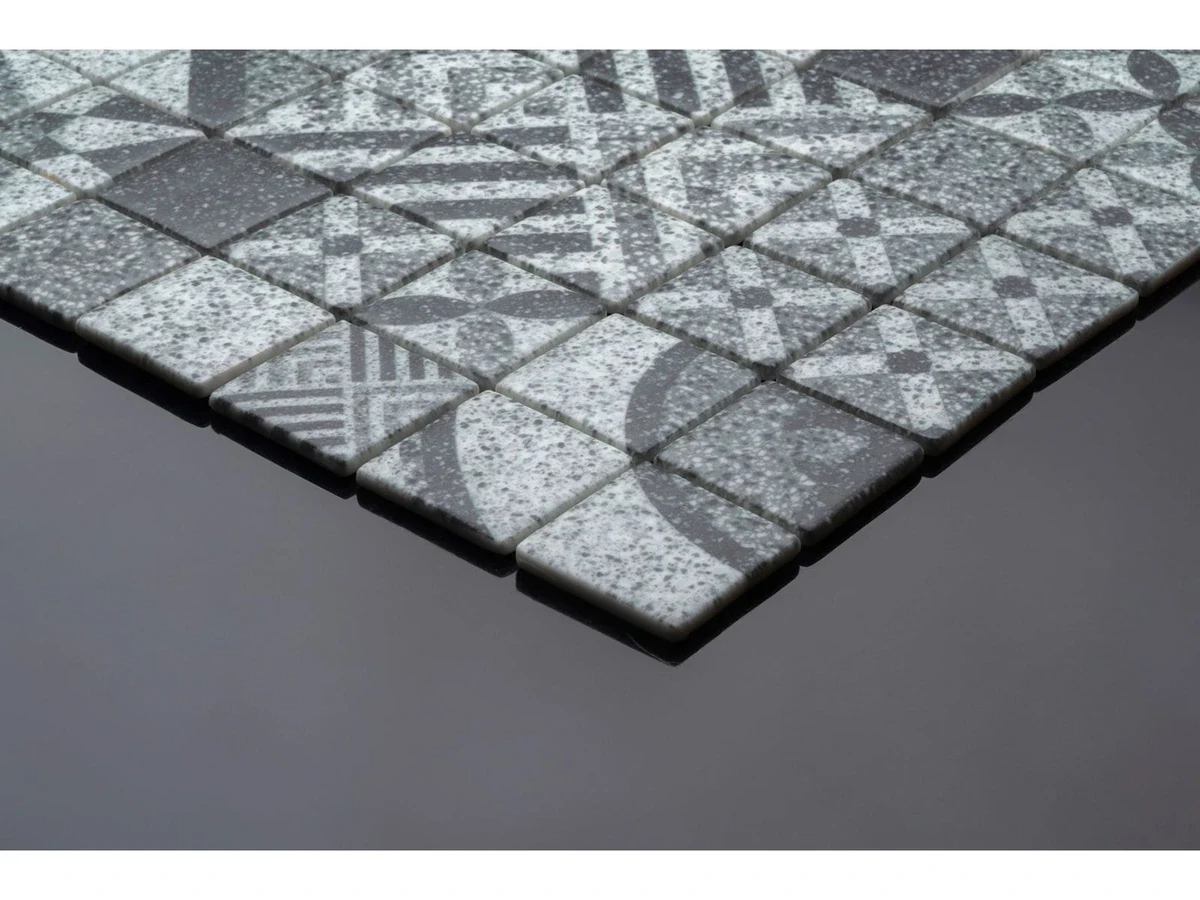
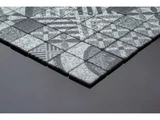
Aosta is a glass-ceramic cladding with square 50 × 50 mm chips and a black-and-grey geometric pattern. The surface looks rich and orderly, and water and light give it depth.
The motif combines stripes, squares and circles, arranged as on the floor of an old house, and the grainy terrazzo texture adds volume. It suits a bathroom, kitchen or hallway in an urban style, where you want rich greyish decoration.
Aosta at a glance
- Chips 50 × 50 mm, 6 mm thick
- Sheet 340 × 340 mm – 9 sheets per square metre
- Silicone dot backing
- Article code MOSFBZDJ029
Why glass ceramic
- Non-porous. It absorbs at most 0.04 % water, so the surface does not hold stains or odours and does not develop mould.
- Lasting colour. It does not fade in the sun (ISO 4892) and does not react to cleaning products (class A under ASTM C650).
- Frost-resistant. It withstands alternating freezing and thawing (ASTM C1026), i.e. it is also suitable for outdoor areas.
- Strong. Flexural strength reaches 55 N/mm² (EN ISO 10545-4), and the face of the tiles is flawless.
- Eco-friendly. The raw material is entirely recycled glass (100 %); the colours contain no lead, cadmium or other heavy metals.
Technical specifications
| Parameter | Value |
|---|---|
| Article code | MOSFBZDJ029 |
| Material | glass ceramic (100 % recycled glass) |
| Shape | square with a printed design |
| Colour and design | black-and-grey geometric pattern |
| Chip | 50 × 50 mm |
| Tile thickness | 6 mm |
| Sheet (size) | 340 × 340 mm |
| Sheets per 1 m² | 9 |
| Sheet backing | silicone (polyurethane) dots |
| Recommended joint | 2 mm |
| Water absorption | no more than 0.04 % according to EN ISO 10545-3 |
| Flexural strength | 55 N/mm² |
| Freeze-thaw cycles | withstands them, ASTM C1026 |
| Resistance to chemicals | class A, ASTM C650 |
| Packaging | 1 m² carton |
The silicone dot backing
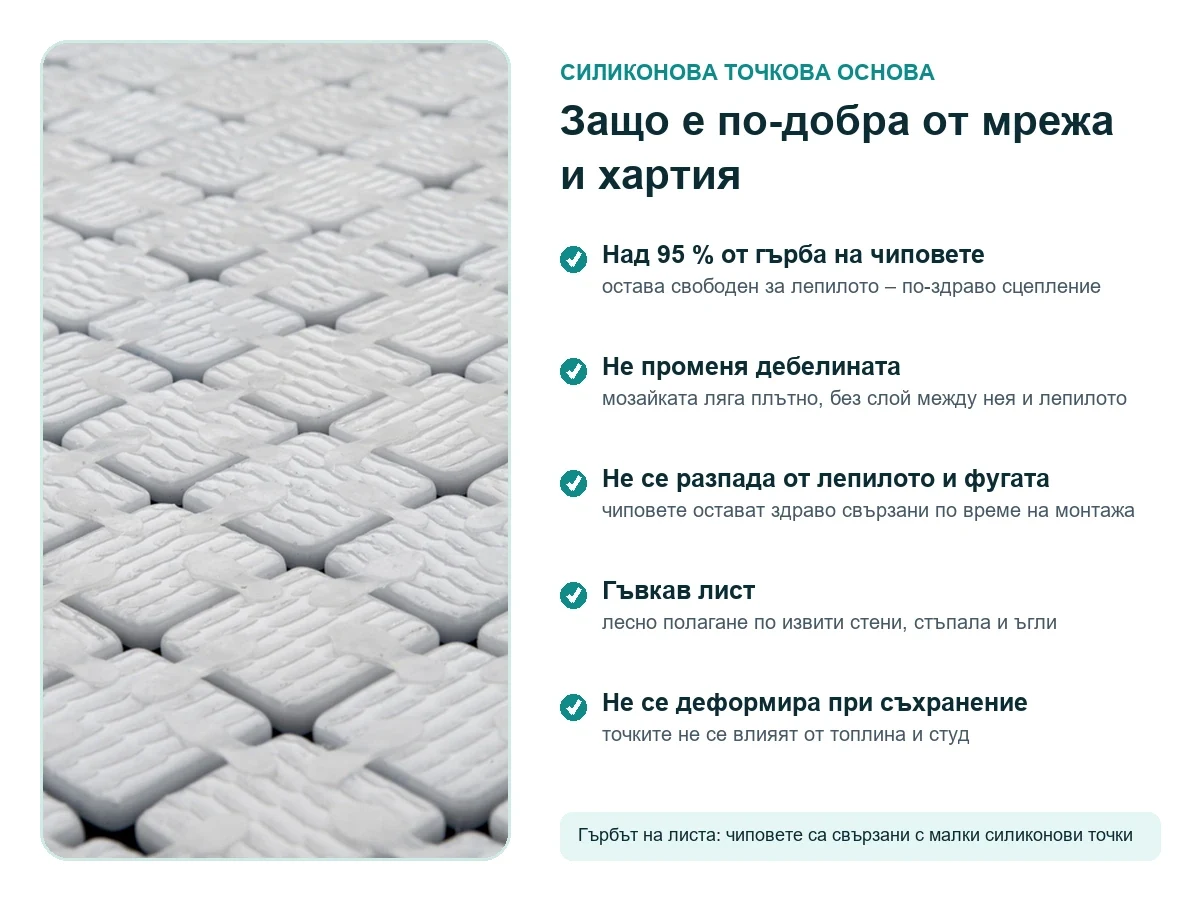
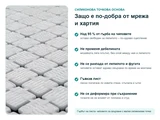
The chips are fixed to a flexible backing of silicone (polyurethane) dots. They connect the tiles only at certain points and do not cover their backs, so over 95 % of each chip stays free for the adhesive. This makes the bond more stable, and the thickness of the sheet does not change. Adhesive and grout do not corrode it, and it does not warp in storage. Thanks to the flexible sheet, the cladding follows curved walls, steps and corners.
| Indicator | Silicone dots | Mesh | Paper |
|---|---|---|---|
| Adhesive access to the back | over 95 % of the back | less, because the mesh covers part of it | the whole back, but the paper is on the face |
| View during installation | chips and joints are visible | chips are visible | chips are under the paper |
| Laying on curves and corners | effortless | easy | difficult, the paper tears |
| After bonding | nothing to remove | nothing to remove | the paper has to be soaked and peeled off |
Where to use it
- Bathroom and hallway in an urban style
- Kitchen with graphic accents
- Wall in a shower area
Glass ceramic is intended for wall cladding in bathrooms, showers, kitchens, spa centres and hammams; it is resistant to cleaning products.
Choosing the grout
A grey or graphite grout keeps the pattern in a single palette. In wet areas and showers the grout must be epoxy or waterproof C2, because it does not let moisture through and does not darken.
How to install it
- Preparing the substrate. The substrate must be dry, sound and free of dust, with a flatness of up to 2 mm over two metres. In the shower area, waterproofing is applied first.
- Adhesive. A white flexible cement-based adhesive C2TE S1 is suitable. Glass is slightly translucent, and a grey adhesive would darken the colour.
- Application. Spread a layer of adhesive for two to three sheets at a time, using a notched trowel with 3–4 mm teeth.
- Placing. Press the sheet evenly with a rubber float and keep the same 2 mm gap between the sheets.
- Cutting. At corners and around openings, cut through the silicone dots with a utility knife; individual chips are cut with special glass mosaic nippers.
- Grouting. Wait a day. In wet areas, grout with an epoxy or waterproof C2 mix.
- Cleaning. Wipe off excess grout with a damp sponge while it is still soft; traces of epoxy mix are removed immediately with a special cleaning agent. Do not enter the shower until the grout has fully hardened.
Have ready: a sponge, a bucket of clean water, a utility knife, glass mosaic nippers, a rubber float and a notched (3–4 mm) trowel, as well as the white adhesive C2TE S1 and the epoxy or waterproof grout.
Approximate consumption
The adhesive is used at an average of 2 kg/m² for small chips (up to 25 mm), 2.5 kg/m² for 40 mm chips and 3 kg/m² for even larger ones. The exact consumption depends on how smooth and how absorbent the floor or wall is, on the chosen materials, the teeth of the trowel and the experience of the installer. Confirm the quantities against the documentation of the adhesive and grout and with the contractor. When ordering, set aside a 5–10 % reserve for cutting and take the whole quantity at once – that way all the cartons come from the same batch and have the same shade.
What the laboratory tests show
- According to ISO 4892, the colour does not change after artificial UV ageing.
- According to ASTM C1026 the material withstands freeze-thaw cycles, and according to ASTM C650 it does not change on contact with chemicals (class A).
- EN ISO 10545-2 records 100 % of surfaces free of defects.
- EN ISO 10545-3 measures water absorption of up to 0.04 %, and EN ISO 10545-4 – a flexural strength of 55 N/mm².
- Under temperature changes (thermal expansion, EN ISO 10545) the cladding holds up.
Caring for the cladding
- Clean with a soft cloth or sponge and a neutral cleaner.
- Do not use abrasive powders, wire brushes or acidic products on the grout.
- After a shower, go over the surface with a silicone glass squeegee – this leaves no water marks.
Frequently asked questions
What adhesive does Aosta need?
A white flexible cement-based adhesive C2TE S1, which does not change the colour of the glass.
Can it go over old tiles?
It can, if the existing cladding holds firmly, has been cleaned of grease and primed.
Is it suitable for salt and chlorinated water?
It is intended for walls and wet rooms, and the glass does not react with cleaning products.
How much does the colour in the photo differ from the real one?
Glass is a living material and the perception of colour depends on the lighting. The brightness and type of the screen also have an effect, so on site the shade may differ slightly from the photos.